-

Off-road
-

SUV
-

ATV / Quad
-

Industrial
-

Van
-

Passenger


Choosing ATV/UTV tyres is one of the most critical decisions an off-road vehicle owner has to make. In most cases, you aren't planning to change your rims – you are looking for tyres that perfectly fit your current wheels. Although standard 10, 12, and 14-inch rims dominate the market, modern, powerful machines and UTVs increasingly require large tyres for 15 or even 16-inch rims.
The key to fully unlocking your quad's power and ensuring safety is understanding how the tread works and knowing how to correctly read tyre sizes. This guide will teach you how a tyre's construction affects its off-road performance and why "more aggressive" doesn't always mean "better."
1. Secrets of Tread Construction – Spacing, Lugs, and Patterns
The tread pattern determines how a tyre interacts with the surface. The width of the gaps between the lugs (also called paddles) and their shape serve a functional purpose.
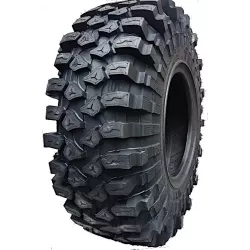
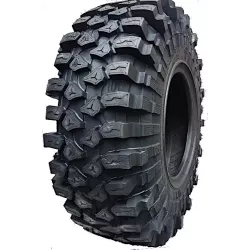
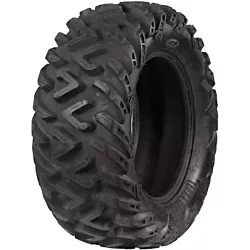
Extreme and Mud Tread (Wide Spacing Between Lugs)
- Construction: The lugs are massive, very deep, widely spaced, and arranged in an aggressive chevron or deep paddle pattern. Uncompromising tyres like the ITP Cryptid are the benchmark for this category.
- How it works: Huge spaces between the lugs are responsible for the self-cleaning feature. When the wheel spins in thick muck, centrifugal force flings the mud outwards. If the lugs were close together, mud would immediately pack the tyre, creating a smooth surface with zero traction. Aggressive paddles literally "paddle" through the bog, searching for a firm bottom.
- ⚠️ Important note for the user: You must remember that an extreme mud tyre will perform terribly during fast rides through the woods or on gravel. On hard packed surfaces, this type of tread generates massive vibrations, makes the quad handle unstable, and the tyres themselves wear down rapidly. If your riding consists mostly of recreation, forest trails, and lighter terrain, choosing such an aggressive tread defeats the purpose. For the average rider, an all-terrain tyre is a much better and safer choice.
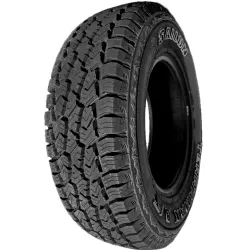
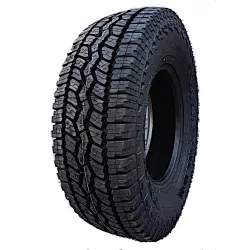
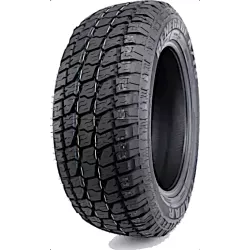
All-Terrain and Gravel Tread (Dense Lug Spacing)
- Construction: The lugs are lower, feature a flatter crown, and are positioned very close to each other.
- How it works: This layout drastically increases the tyre's contact patch with the ground. It provides stability on hard surfaces – the machine does not "vibrate," rides quietly, and handles precisely. Additionally, wrap-around shoulder lugs protect the wheel from side impacts and help climb out of ruts. The legendary design in this category is the classic "Bighorn" style layout, excellently represented by SunF tyres (a mid-range hit) or iconic premium tyres from Maxxis.
2. Size Cheat Sheet – What Do These Numbers Mean?
When buying tyres for your current rims (whether they are 8, 9, 10, 12, 14, or massive 15 and 16 inches), you will encounter a designation consisting of three numbers, such as 25x8-12 or 26x9-14. What exactly does this mean?
- First number (e.g., 25, 26, or other): The total height (outer diameter) of the tyre in inches.
- Second number (e.g., 8, 9, or other): The width of the tyre in inches. Note that the rear of the quad almost always requires a wider tyre than the front to better transfer engine power.
- Third number (e.g., 12, 14, 15): The rim diameter in inches. This value must properly match your current wheels.
Slightly Upsizing – How Many Centimetres is That?
When replacing a worn set, many riders choose to keep their rims but select tyres with slightly larger parameters. For example: instead of a factory 25x8-12 and 25x10-12 set, they mount tyres sized 26x9-12 and 26x11-12. There are, of course, plenty of other combinations for larger rims, but the principle always remains the same.
It is worth knowing how such a change affects the physics of the vehicle:
- Difference in height: Moving up by one inch (e.g., from 25 to 26 inches) increases the quad's ground clearance by about 1.2 cm to 1.5 cm (half an inch in each direction from the axle).
- Difference in width: A tyre that is 1 inch wider (e.g., from 8 to 9) means about 2.5 cm more rubber in terms of width.
Such a subtle change allows the tyre to absorb bumps slightly better and provides a marginally larger tread contact patch with the ground. However, keep in mind that larger and heavier rubber also adds a bit more resistance for the suspension and power steering system. The ultimate choice always depends on your individual needs and whether the factory specs were fully sufficient for you.
3. Low Pressure in an ATV – Why is it So Important?
One of the most common mistakes made by beginner quad owners is over-inflating the tyres. Remember: ATV/UTV tyres are low-pressure tyres. They operate on a completely different principle than passenger car tyres.
- Correct pressure: Depending on the quad model, vehicle weight, and terrain, standard tyre pressure is typically just between 0.3 and 0.7 bar (PSI ranging from 4–10).
- Why so low? A soft, slightly under-inflated tyre can "wrap" itself around an obstacle it drives over. This allows the tread to conform to the shape of rocks, roots, or uneven ground, guaranteeing maximum traction. Additionally, low pressure enables the tyre to act as the primary suspension element, absorbing minor impacts and vibrations.
- Risk of over-inflation: Inflating the wheel to values typical for cars (e.g., 1.5 or 2.0 bar) will make the tyre hard as a rock. The quad will start bouncing drastically over bumps, lose contact with the ground, and the tread lugs will bounce off the terrain instead of biting into it. This also increases the risk of easily puncturing or cutting the tyre on a sharp rock.
4. Important Before Buying: Road Homologation or NHS?
When buying quad tyres, you must pay attention to another key designation that determines where you can legally drive:
- Road Homologation (E-marking): Tyres with the "E" symbol (e.g., E4) and a string of digits have passed strict tests and are officially approved for public road use. If your quad is registered and you happen to drive on asphalt roads or public gravel paths, you must choose tyres with E-homologation.
- NHS Marking (Not for Highway Service): Tyres with this acronym do not have road homologation. They are designed exclusively for competitive, sport, and off-road riding, away from public roads. They work perfectly on closed tracks, private property, or deep wilderness, but you are not allowed to drive them on asphalt.
5. Choosing a Tyre Brand – Match the Product to Your Demands
At Opony4x4.eu, we make sure that every quad owner finds the perfect tread for their riding style and budget:
- Premium Class (Maxxis, ITP, Carlisle, Carlstar): Solutions for the most demanding riders. Maxxis tyres (with famous models like Bighorn or Zilla), extreme ITP (Cryptid), and Carlisle/Carlstar stand out due to excellent balancing, very advanced rubber compound formulas, and come as original equipment (OE) on many top factory quads.
- Mid-Range Class (SunF, Duro): The SunF brand is an absolute hit – it offers an amazing price-to-quality ratio and proven, highly durable all-terrain patterns. On the other hand, Duro is synonymous with bulletproof construction. Their tyres feature a thick, multi-ply construction (high PR rating), making them exceptionally resistant to punctures from sharp branches.
- Economic Class (Journey): A great and affordable alternative for those looking for solid rubber for recreational, weekend trips without overpaying.
We will help you gear up your quad!
Whether you are looking for an all-terrain SunF A-033 tyre with road homologation, or thinking about an extreme NHS mud monster from ITP Cryptid for a massive rim – we are here to help. Our team, with years of off-road experience, knows exactly how to match technical requirements with your riding style. We will advise you on which pattern and specs will work best for your machine!
Feel free to contact us – we will select tyres that will allow you to rediscover your quad's capabilities!
(4) 0